AP Physics 2 Score Calculator: How to Convert Raw Scores to AP Grades
An AP Physics 2 score calculatorlets you predict your final 1-5 AP grade before the College Board releases official results in July. By entering your estimated multiple-choice and free-response raw scores into this tool, you get an instant composite score and grade prediction based on historical cutoff data. Whether you're finishing a practice exam or decompressing after the real test, this calculator shows exactly where you stand — and what it would take to reach the next grade level.
What Is the AP Physics 2 Exam?
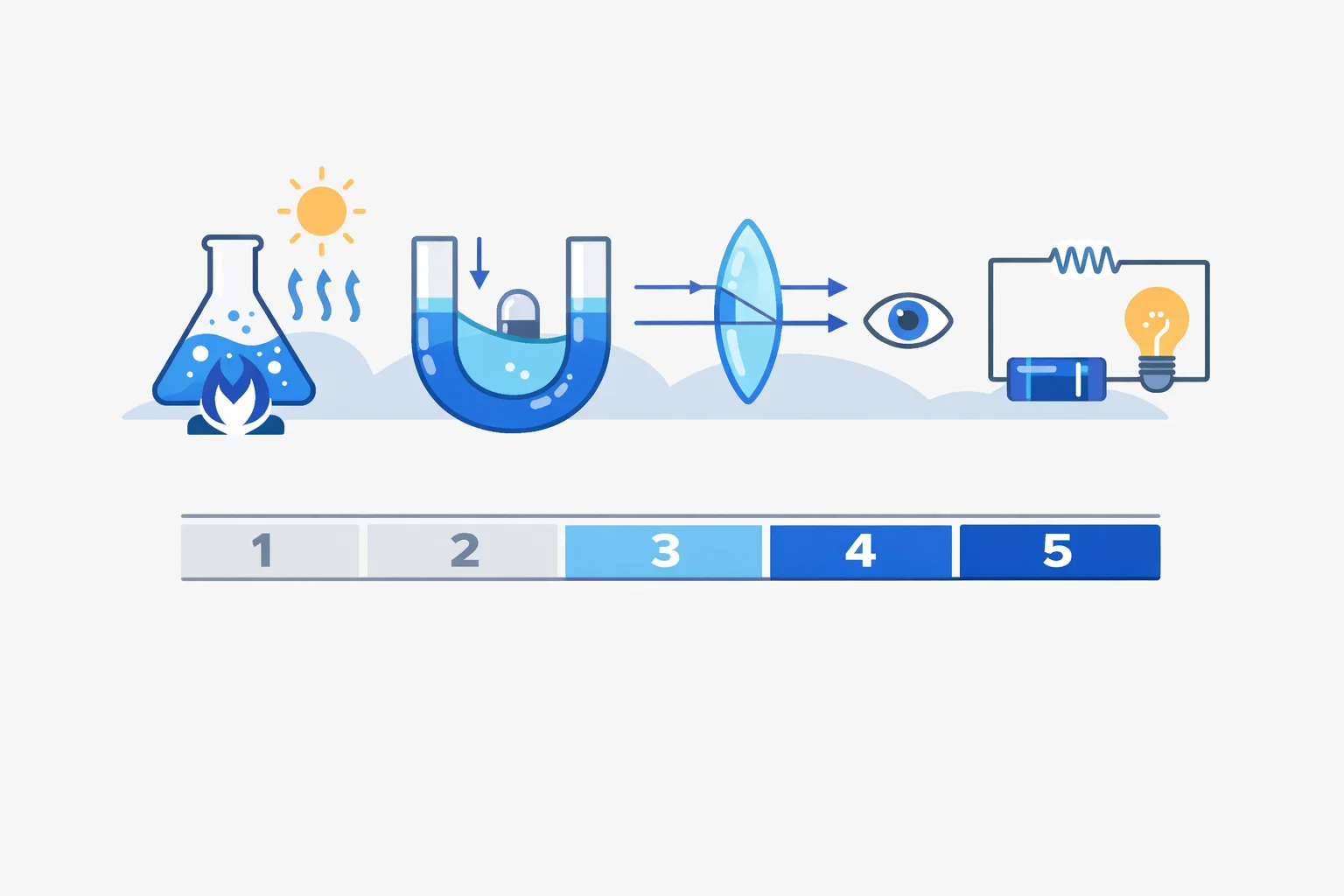
AP Physics 2: Algebra-Based is the second course in the College Board's algebra-based physics sequence, designed as a follow-up to AP Physics 1. While AP Physics 1 covers mechanics — forces, energy, momentum, rotation — AP Physics 2 tackles the topics that mechanics left out: thermodynamics, fluid mechanics, electrostatics, DC circuits, magnetism, electromagnetic induction, optics, and quantum/atomic/nuclear physics.
The exam is 3 hours long and split evenly into two sections. Section I contains 40 multiple-choice questions in 90 minutes. Section II has 4 free-response questions in 90 minutes. Each section counts for exactly 50% of your final score. About 22,000-25,000 students take AP Physics 2 each year — far fewer than the 160,000+ who take AP Physics 1, which contributes to the exam's higher pass rate.
How AP Physics 2 Scoring Works
The scoring process converts your raw points into a composite percentage, which is then mapped to the 1-5 AP scale. Here is how each section works:
- MCQ Raw Score = Number of correct answers out of 40 (no penalty for guessing)
- FRQ Raw Score = Sum of points across all 4 questions (each scored 0-15, max 60 total)
- Composite % = (MCQ% + FRQ%) / 2, where MCQ% = MCQ Raw / 40 × 100 and FRQ% = FRQ Raw / 60 × 100
The College Board uses a process called equating to ensure that scores are comparable across different test administrations. This means the exact cutoff percentages shift slightly from year to year based on exam difficulty. However, the approximate ranges have remained fairly stable over the past five years. If you're also preparing for the algebra-based mechanics exam, try our AP Physics 1 Score Calculator to predict that score as well.
Raw Score to AP Grade Conversion
Based on historical data from College Board publications, here are the estimated composite percentage ranges for each AP Physics 2 grade:
- 5 (Extremely well qualified): 67% and above — roughly 27+ MCQ correct and 40+ FRQ points
- 4 (Well qualified): 52-66% — roughly 21 MCQ correct and 31 FRQ points
- 3 (Qualified): 37-51% — roughly 15 MCQ correct and 22 FRQ points
- 2 (Possibly qualified): 24-36% — roughly 10 MCQ correct and 14 FRQ points
- 1 (No recommendation): Below 24%
A score of 3 is the minimum for college credit at most institutions. Earning a 3 on AP Physics 2 requires about 37% of the available points — that means getting roughly 15 out of 40 MCQ correct and earning 22 out of 60 FRQ points. While this sounds manageable, the exam's conceptual difficulty and broad topic coverage make it harder than the numbers suggest.
MCQ Section Breakdown
The 40 multiple-choice questions cover all seven content areas with the following approximate weight distribution:
- Thermodynamics: 12-18%
- Fluid Mechanics: 10-16%
- Electrostatics: 14-18%
- DC Circuits: 10-14%
- Magnetism & Electromagnetic Induction: 10-16%
- Geometric & Physical Optics: 10-16%
- Quantum, Atomic & Nuclear Physics: 10-14%
You have 90 minutes for 40 questions, giving you about 2 minutes and 15 seconds per question. Some questions are multi-select (choose two correct answers), and many require analyzing diagrams, graphs, or experimental data. There is no guessing penalty, so always answer every question — a random guess on a four-option question gives you a 25% chance of earning a point.
FRQ Section Breakdown and Scoring Tips
The free-response section has 4 questions, each worth 15 points (60 total). The FRQ types on the current AP Physics 2 exam are:
- FRQ 1 — Experimental Design: Design an experiment, describe a procedure, collect and analyze data (15 pts)
- FRQ 2 — Qualitative/Quantitative Translation: Connect mathematical representations to physical scenarios (15 pts)
- FRQ 3 & 4 — Short Answer: Multi-part problems involving calculations, explanations, and justifications (15 pts each)
AP readers award partial credit on every FRQ part. A critical strategy: always show your reasoning and write something for every sub-part, even if you are uncertain. Students frequently earn 7-10 out of 15 points on questions where their final answer was wrong but the physics reasoning was partially correct. Label all diagrams, include units in every calculation, and state the physics principle you are applying (e.g., "By conservation of energy..." or "Applying Gauss's law...").
AP Physics 2 Score Distributions by Year
AP Physics 2 has consistently maintained one of the higher pass rates among AP science exams. Here is a summary of recent score distributions:
- 2024: 14.0% scored 5, 19.4% scored 4, 33.0% scored 3 — 66.4% pass rate
- 2023: 14.9% scored 5, 18.2% scored 4, 30.3% scored 3 — 63.4% pass rate
- 2022: 14.0% scored 5, 18.0% scored 4, 31.0% scored 3 — 63.0% pass rate
- 2021: 14.3% scored 5, 18.5% scored 4, 30.0% scored 3 — 62.8% pass rate
- 2020: 16.5% scored 5, 17.9% scored 4, 29.1% scored 3 — 63.5% pass rate
The pass rate has hovered between 63% and 67% across these five years. The percentage earning a 5 is about 14-16%, which is nearly double the rate for AP Physics 1 (about 8%). This reflects the self-selected student population — students who take AP Physics 2 have typically already completed AP Physics 1 and are more experienced with college-level physics.
AP Physics 2 vs AP Physics 1: Key Differences
Many students wonder how these two exams compare. Here are the most important differences:
- Content:Physics 1 covers mechanics (forces, energy, momentum, rotation). Physics 2 covers everything else: thermodynamics, fluids, E&M, optics, and modern physics.
- FRQ count: Physics 1 has 5 FRQs worth 12 points each. Physics 2 has 4 FRQs worth 15 points each. Both sections total 60 FRQ points.
- Pass rate: Physics 2 has a significantly higher pass rate (~65%) compared to Physics 1 (~48%), but fewer students take it.
- Difficulty: Physics 2 topics are often considered more abstract (electric fields, wave optics, quantum mechanics), but the smaller test-taking population tends to be better prepared.
- College credit:Most colleges treat them as separate courses. Physics 1 credit typically covers introductory mechanics, while Physics 2 covers introductory E&M and modern physics.
If you are considering the calculus-based track instead, our AP Physics C Score Calculator covers both the Mechanics and Electricity & Magnetism exams. For a focused Mechanics prediction, check the AP Physics C Mechanics Score Calculator.
Tips to Improve Your AP Physics 2 Score
If your predicted score is lower than your target, these strategies can help:
- Master electrostatics:With 14-18% exam weight, electrostatics is the single largest topic. Understand electric fields, potential, and Gauss's law conceptually — not just the formulas.
- Practice FRQ experimental design: FRQ 1 is always an experimental design question. Practice writing clear procedures, identifying variables, and explaining how you would analyze data. Released FRQs from the College Board website are the best resource.
- Connect topics across units: AP Physics 2 frequently tests cross-unit connections. For example, a question might combine fluid pressure with thermodynamic processes, or link circuit behavior to magnetic fields. Practice recognizing these connections.
- Focus on weak areas strategically: With 7 content areas, spending equal time on all of them is inefficient. Identify your weakest 2-3 areas and focus study there — improving from 30% to 60% in a weak area gains more points than going from 80% to 90% in a strong one.
- Review optics ray diagrams and lens equations: Optics questions often involve tracing light rays through lenses and mirrors. These problems are methodical and highly learnable — students who practice ray diagrams consistently score well on this section.
When to Use This AP Score Calculator
This AP Physics 2 score calculator is most useful in these situations:
- After completing a full-length practice exam to convert raw scores to a predicted AP grade
- Immediately after the real AP exam to estimate your score while your performance is fresh
- During study planning to set target scores for each section and identify how many more points you need
- When comparing your progress across multiple practice tests over time
- To understand the relative impact of MCQ vs FRQ improvement on your final grade
Keep in mind that this calculator uses estimated cutoffs based on historical data. Actual College Board cutoffs may vary by 1-3 percentage points depending on exam difficulty in any given year. Use your predicted grade as a guide for study planning, not as a guarantee.